THE CANOE LAKE FILES
Why Tom Thomson Still Fascinates Us
January 17, 2026
Mystery, Martyrdom, and the Birth of a Canadian Art Myth
More than a century after his death, Tom Thomson remains one of the most compelling figures in Canadian cultural history. His paintings are reproduced endlessly, his life is taught in schools, his name is invoked whenever Canadian art is discussed—and, perhaps most tellingly, his death is still debated.
This persistence of interest raises an obvious question: why?
Thomson left behind a relatively small body of work. He was not widely famous during his lifetime. He died at thirty-nine, before formal recognition, before a major exhibition, before he could see the influence he would exert. And yet his reputation has not merely endured—it has grown.
We believe the answer lies not only in the paintings themselves, but in the circumstances of his death, and in how that death transformed both his legacy and Canadian art itself.
“THE ENDURING POWER OF MYSTERY
History shows that artists who die under mysterious or tragic circumstances often become objects of sustained fascination. Their work is no longer viewed solely on its own merits; it becomes inseparable from the narrative of loss, injustice, or unanswered questions.
Perhaps the most famous example is Vincent van Gogh. During his lifetime, Van Gogh sold almost nothing and was regarded as a marginal figure. After his death—long attributed to suicide but increasingly questioned—his work became iconic. The drama of his life and death intensified interest in his paintings, encouraging audiences to read emotional depth, suffering, and prophecy into the canvases themselves.
Other artists follow similar trajectories: tragic deaths, unresolved questions, and posthumous elevation. Mystery acts as an accelerant. It compels attention. It invites interpretation.
Tom Thomson fits this pattern almost perfectly.
FROM OBSCURITY TO ICON
A DEATH THAT REFUSED TO SETTLE
If Thomson had died peacefully, or even clearly—through an unambiguous accident—his work might still be admired, but it is doubtful that his name would carry the same mythic weight. Instead, he died alone on Canoe Lake under circumstances that were never properly investigated, leaving behind contradictions, rumors, and a century of unresolved debate.
That unresolved quality matters.
Human beings are drawn to stories without endings. Thomson’s death does not resolve; it lingers. Every generation re-encounters it and asks the same questions: What really happened? Who knew what? Why was nothing ever settled?
In that sense, Thomson is not just an artist; he is a permanent question.
A RISING TIDE FLOATS ALL BOATS
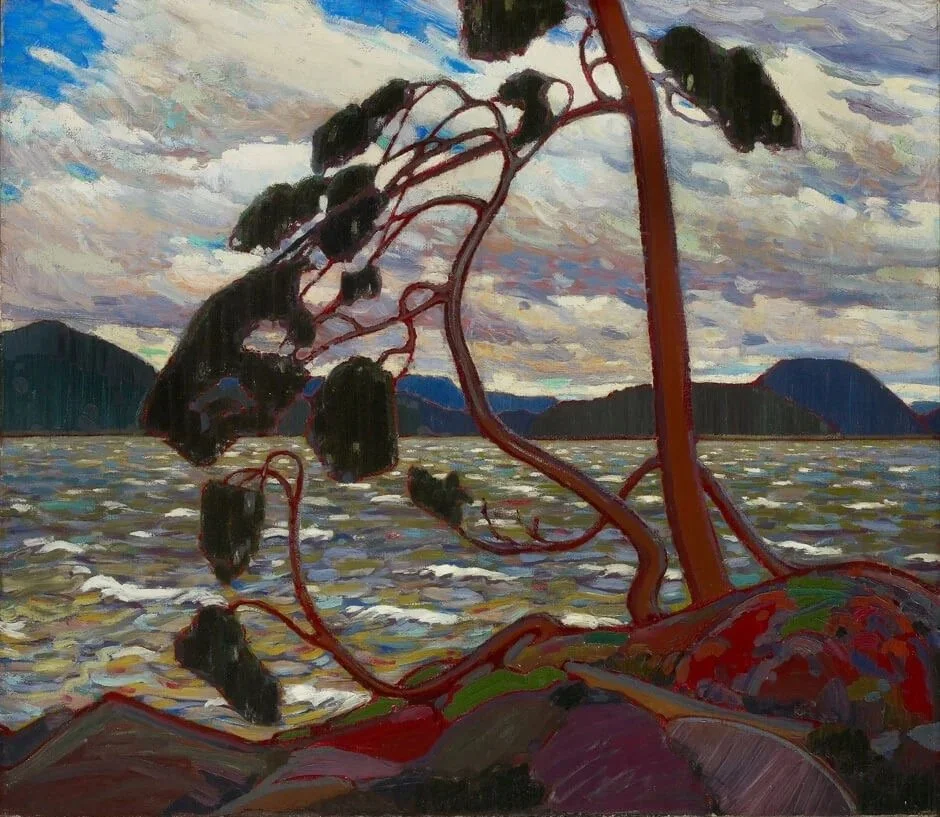
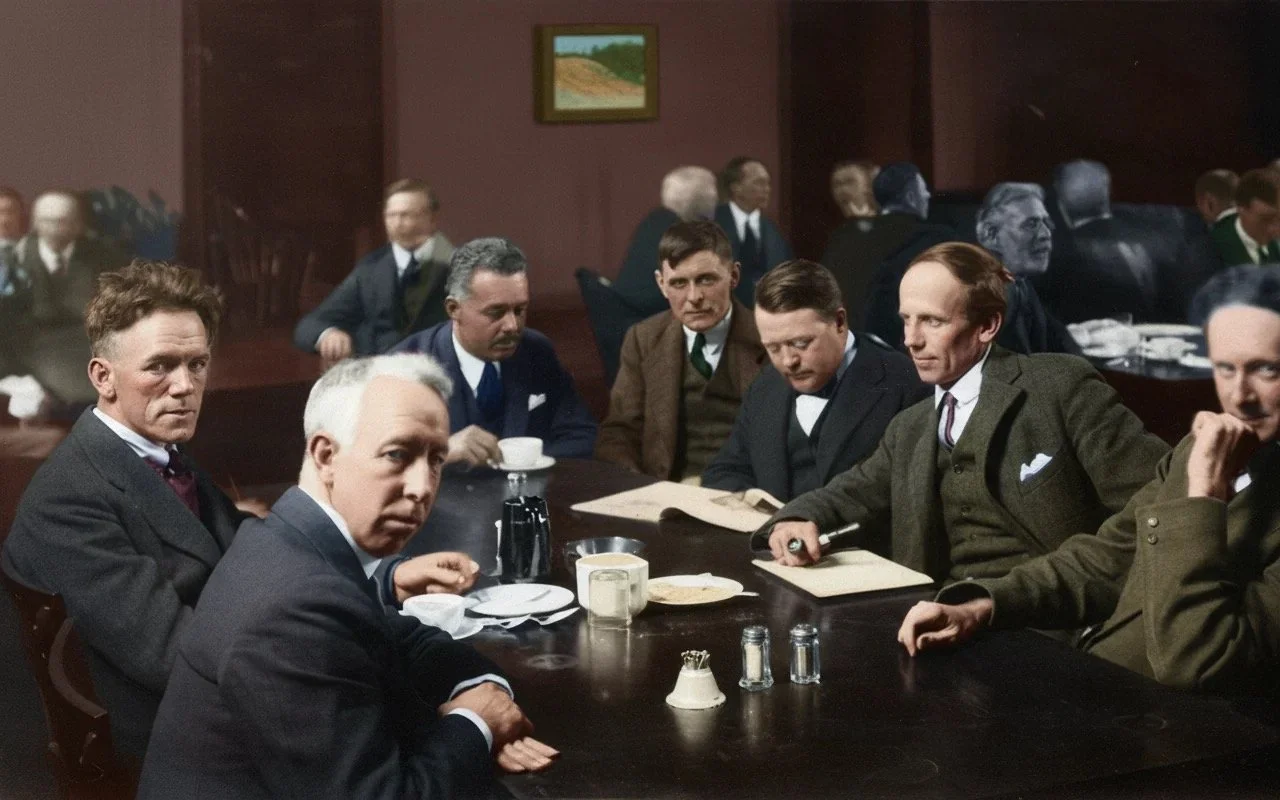
The Group of Seven were already developing a new approach to landscape painting, but it was Thomson’s posthumous elevation that provided a powerful focal point. He became the symbolic origin—the solitary pioneer who had gone ahead and paid the price. Thomson’s death gave the emerging movement:
A martyr
A narrative of sacrifice
A sense of destiny interrupted
Without his death, the Group’s story would still exist—but it would lack its emotional core. Seen this way, Thomson’s death did more than end a life. It created a mythology. And mythology is what carries art beyond its immediate historical moment.
It is important to remember that Thomson was not a household name in 1917. Although he had sold four paintings to major galleries prior to his death - in 1913, he sold “Northern Lake”(painted in 1912–13) to the Government of Ontario (now part of the Art Gallery of Ontario collection) for $250; the National Gallery of Canada purchased three works “Moonlight” (painted in 1913–14) in 1914 for $150, “Northern River*” (painted in 1915) in 1915 for $500, and “Spring Ice” (painted in 1915–16) in 1916 for $300 - he was not celebrated nationally. His reputation rose rapidly only after he died.
In the book Who Killed Tom Thomson?, the theory is advanced that if Thomson was murdered, his killer may have inadvertently launched the Canadian art movement.
The logic is unsettling—but persuasive.
The intrigue surrounding his death drew attention to his work. That attention elevated his reputation. And once Thomson became a figure of fascination, those who had worked with him—those who had painted beside him, learned from him, or been inspired by him—were drawn into the same orbit of interest.
By extension, this included the artists who would soon be known collectively as Group of Seven.
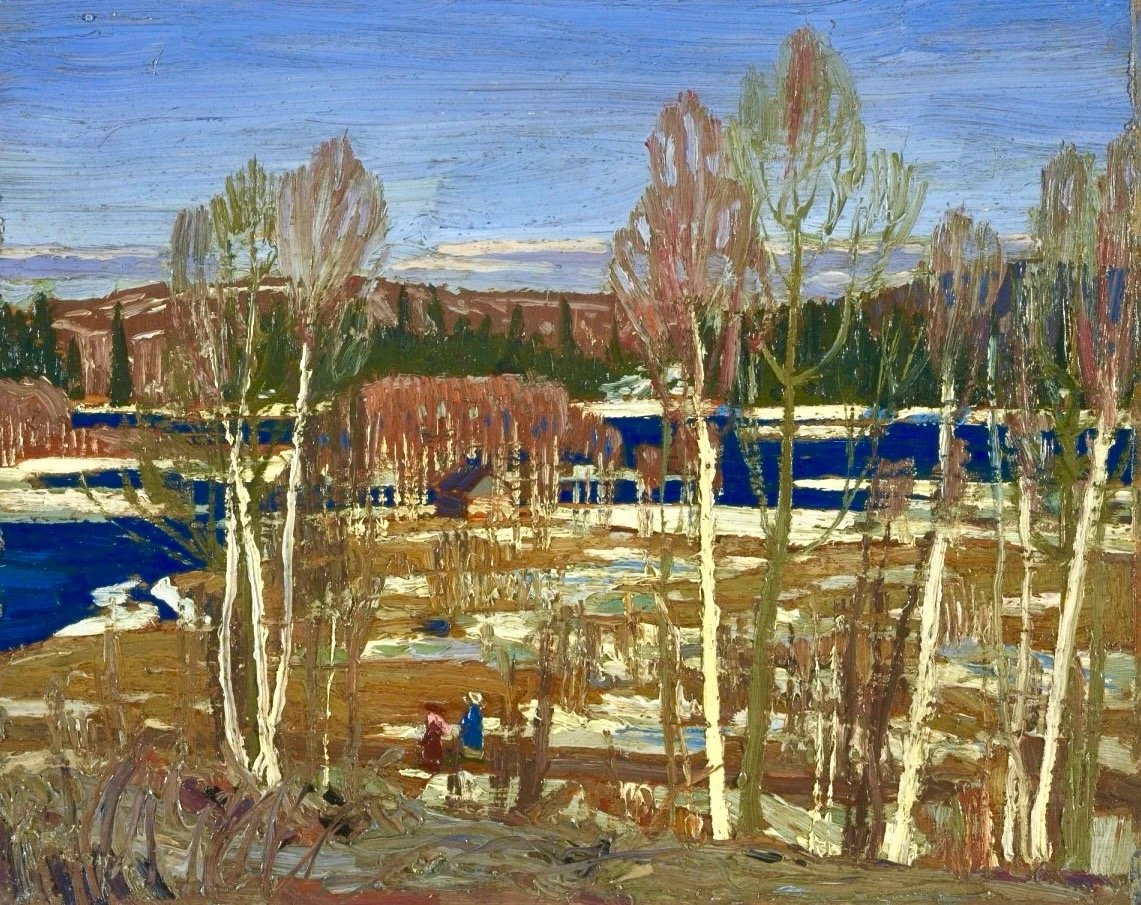
“Larry Dixon’s Cabin” by Tom Thomson (1916)
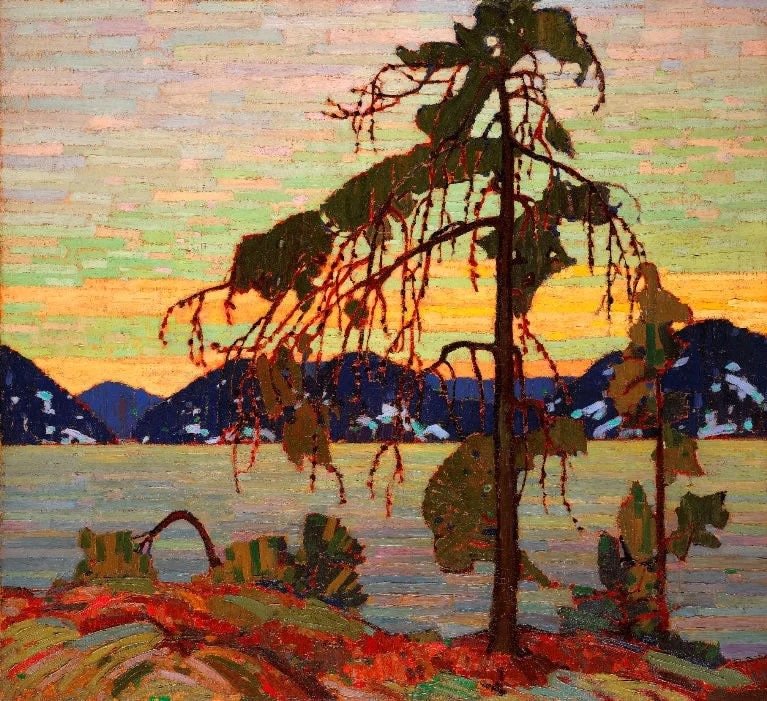
Another reason public fascination endures is that Thomson’s paintings seem to invite narrative. His landscapes are not grand in scale; they are intimate, solitary, and often stark. They feel personal. Knowing that he died alone in the same wilderness he painted invites viewers to read meaning into every brushstroke.
This is not accidental. We do not look at Thomson’s work the way we look at purely formal abstraction. We look at it biographically. We ask what he saw, what he felt, and what he knew.
The mystery of his death turns each painting into a kind of clue—or, at least, a relic.
Canada’s Need for an Origin Story
There is also a broader cultural reason for Thomson’s enduring appeal.
Canada, as a nation, was still young in 1917. It lacked deep-rooted cultural myths of its own making. Thomson’s story—an artist immersed in wilderness, dying young, leaving behind work that defined a national aesthetic—filled that void.
He became not just a painter, but a symbol of:
Artistic independence
Connection to land
A uniquely Canadian sensibility
Mystery enhanced that symbolism. A clear, mundane death would have diminished it.
Why the Fascination Persists Today
After reading the historical record, examining the competing theories, and observing a century of public engagement, several reasons stand out for why Thomson still fascinates us:
His death was never resolved, leaving room for speculation.
His work is inseparable from place, making the story tangible.
His reputation rose only after death, reinforcing the sense of lost potential.
His story intertwines with the Group of Seven, amplifying its cultural reach.
Mystery invites reinterpretation, allowing each generation to rediscover him.
Most artists are eventually “settled” by history. Thomson never has been.
Conclusion: Would We Still Be Talking About Him?
This leads to the most uncomfortable question of all.
If Tom Thomson had not died under mysterious circumstances—if he had lived into old age, produced more work, and faded quietly into the art historical record—would we still be talking about him with the same intensity?
Perhaps. But probably not.
It is the combination of talent and tragedy, of beauty and uncertainty, that keeps his story alive. And if it is true that his death helped ignite public interest in Canadian art at a critical moment, then the irony is profound: an act of violence—or at least of concealment—may have played a role in shaping a national cultural identity.
That possibility does not diminish Thomson’s achievement. If anything, it underscores how deeply his life and death are woven into the fabric of Canadian art.
A century on, we are still looking at his paintings—and still asking why he never came home.